← Back to KodexMessenger
Technology • Cybersecurity • Special Feature • Digital Privacy

The Kodex Dispatch

Vol. I — Special Launch Edition Thursday, 22 May 2026 kxxmessenger.netlify.app
Exclusive

KodexMessenger Is Coming: The Encrypted Platform Built to Make Surveillance Obsolete

A Zambian-built messaging service weaponises military-grade cryptography, zero-knowledge architecture, and vanishing messages to hand control of private communication back to ordinary people.

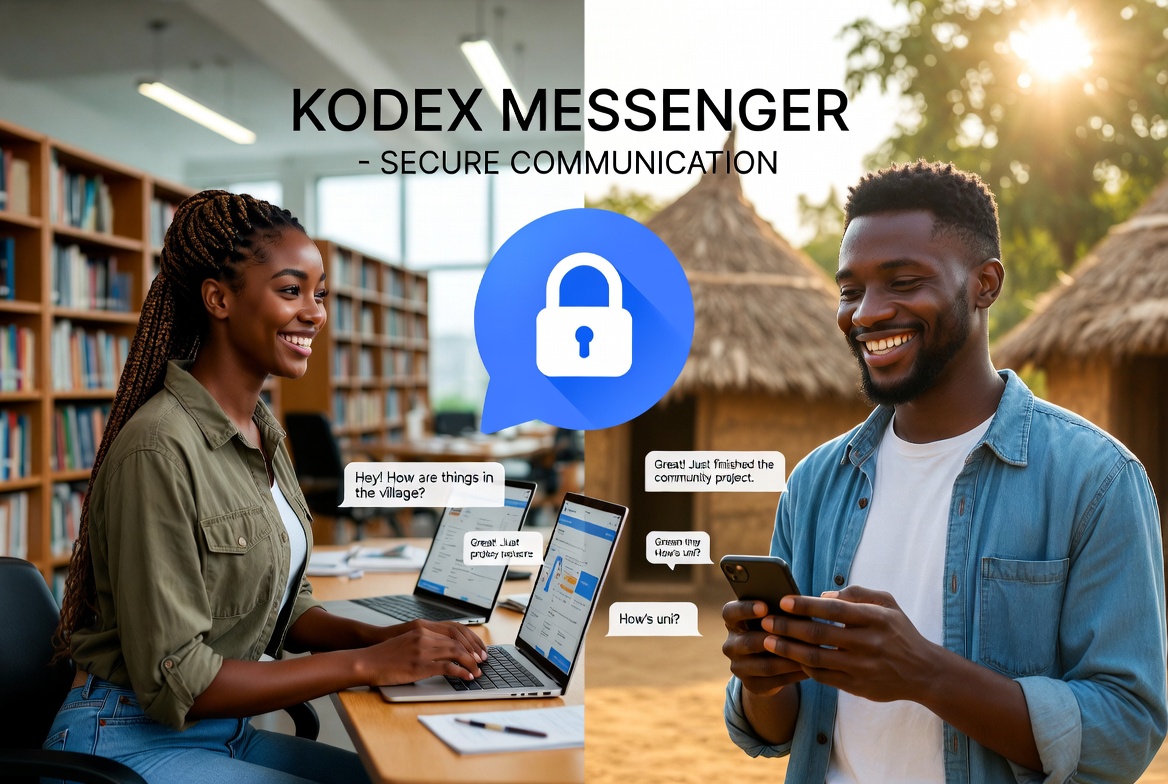
KodexMessenger encrypted conversation interface showing secure session exchange
Above: The KodexMessenger interface in action — two users connected through a cryptographic session code. Messages are encrypted on-device and vanish within seconds of being read. No accounts. No phone numbers. No trace.

Cryptography, derived from the Greek words kryptos (hidden) and graphein (to write), is the ancient science of transforming readable information into unintelligible code. For millennia, it safeguarded military secrets and diplomatic cables. Today, it underpins every secure transaction on the internet — from online banking to medical records. Yet for all its power, mainstream messaging platforms have failed to give everyday users true cryptographic privacy. Most still harvest metadata, store messages on centralised servers, and hand data to governments upon request. KodexMessenger aims to change that equation entirely.

Developed in Zambia by a team deeply aware of the surveillance pressures facing journalists, lawyers, activists, and healthcare professionals, KodexMessenger is a web-based encrypted messaging platform that requires no account registration, no phone number, and no personal information whatsoever. It represents a philosophical break from the status quo: instead of asking users to trust a company with their data, it ensures the company never possesses that data in the first place.

The platform employs AES-256-GCM — the Advanced Encryption Standard with Galois/Counter Mode — the same cipher approved by intelligence agencies worldwide for protecting classified material. But the encryption method is only half the story. What makes KodexMessenger architecturally different is that every cryptographic operation happens on the user's own device, before any data reaches a server. The servers function as blind relay points, shuttling encrypted packets they cannot read, decrypt, or store beyond delivery.

When two users wish to communicate, one generates a unique 15-character cryptographic session code. This code, shared through any channel the users trust, serves as the sole key to the conversation. There are no usernames, no friend lists, no searchable directories. Once both parties enter the session code, a secure channel is established. Messages are encrypted client-side, transmitted through Firebase Realtime Database as cipher-text, and upon being read by the recipient, automatically destroyed from all servers within five seconds. When the session ends, every trace evaporates.

This architecture — known in security circles as zero-knowledge — means that even KodexMessenger's own operators cannot read conversations, comply with data extraction requests, or reconstruct message histories. It is not merely a promise; it is a mathematical guarantee. The encryption keys never leave the users' browsers. The servers are, by design, cryptographically blind.

The platform also incorporates anti-screenshot mechanisms to guard against the most common breach vector in encrypted messaging: the recipient themselves capturing the screen. Coupled with ephemeral message delivery that deletes content seconds after it is viewed, KodexMessenger creates conversations that exist only in the moment they are read — and nowhere else thereafter.

Voice notes and image sharing have also been engineered with the same rigorous encryption pipeline. Media files are encrypted on the sender's device, transmitted in cipher-text, decrypted on the receiver's device, and purged from transit infrastructure once delivered. At no point does an unencrypted file touch a third-party server.

“Privacy is not about having something to hide. It is about retaining the right to choose what you reveal and to whom. KodexMessenger makes that choice irrevocable and mathematically enforced.”
The KodexMessenger Manifesto

Technical Deep Dive

How Kodex Cryptography Works

I
Generate
User creates a unique 15-character cryptographic session code on-device
II
Encrypt
AES-256-GCM encrypts every message, voice note, and image locally in the browser
III
Relay
Cipher-text is relayed through blind servers that cannot read any content
IV
Vanish
Messages auto-delete 5 seconds after reading. Session ends, all data is destroyed

AES-256 is a symmetric-key block cipher that processes data in 128-bit blocks using a 256-bit key. To brute-force a single AES-256 key, an attacker would need to try approximately 1.1 × 1077 combinations — a number so vast it exceeds the estimated count of atoms in the observable universe. The GCM (Galois/Counter Mode) component adds authenticated encryption, meaning any attempt to tamper with a message in transit will be instantly detected and rejected by the receiving client.

KodexMessenger's implementation layers this cipher within a zero-knowledge relay architecture. The encryption and decryption keys are derived from the shared session code and never transmitted to any server. Even if an attacker intercepted every byte of data flowing through the relay infrastructure, they would encounter only meaningless cipher-text with no available key to decrypt it.

What distinguishes this approach from conventional end-to-end encryption used by popular messaging apps is the absence of persistent identity. There are no user accounts to subpoena, no metadata logs linking sessions to real-world identities, and no message archives stored on cloud infrastructure. The session code itself is the only identifier, and it expires when the conversation ends. By eliminating the identity layer entirely, KodexMessenger removes the attack surface that has historically allowed governments and corporations to track, profile, and surveil messaging users even when content encryption is present.

The platform achieves this while running entirely within a standard web browser. There is no application to download from an app store, no software to install, and no permissions to grant. Users simply navigate to the KodexMessenger web application, generate or enter a session code, and begin communicating securely. This browser-native approach dramatically reduces the barriers to adoption and eliminates the trust dependency on app store gatekeepers.

Market Analysis

Why KodexMessenger Is a Disruptive Force

Zero-Knowledge Architecture

Servers relay encrypted data they cannot read. Even with a warrant, there is nothing to hand over.

Ephemeral by Default

Messages self-destruct 5 seconds after being read. Sessions expire. Nothing persists anywhere.

No Identity Required

No names, phone numbers, emails, or accounts. Communication without a digital footprint.

Browser-Native

No downloads, no installations, no app-store gatekeepers. Works in any modern browser instantly.

Built for Emerging Markets

Designed in Zambia for users who need privacy most — journalists, lawyers, activists, and healthcare workers.

Full Media Encryption

Voice notes, images, and file transfers all pass through the same AES-256-GCM encryption pipeline.

The messaging market is dominated by a handful of platforms that have normalised the collection and monetisation of user data. Even those that advertise end-to-end encryption still collect metadata — who messaged whom, when, from where, and how often. This metadata, security researchers have repeatedly demonstrated, can be just as revealing as message content itself. A journalist's contact list, a lawyer's call patterns, an activist's meeting schedule — all are exposed through metadata even when the words themselves are encrypted.

KodexMessenger attacks this problem at the root. By eliminating user accounts, it eliminates the metadata infrastructure entirely. There are no contact lists to harvest, no usage patterns to model, and no social graphs to map. Each session exists as an isolated cryptographic event, disconnected from every other session and from any real-world identity.

For professionals operating in sensitive environments, this architecture represents a paradigm shift. A Zambian journalist investigating government corruption can communicate with a source without creating any digital record linking them. A human rights lawyer can consult with a client across borders without that communication being attributable to either party. A healthcare worker can discuss patient information without violating data protection regulations, because the data never exists in a form that could be breached.

The platform's tiered pricing model — offering a free plan alongside Pro and Business tiers — ensures accessibility while funding ongoing development. The free tier provides full encryption, voice notes, and image sharing with 24-hour session durations. The Pro plan extends sessions to seven days, enables custom session codes, and supports file transfers up to 50 megabytes. The Business plan adds team workspaces for up to ten users, administrative dashboards, and custom branding — making KodexMessenger viable not just for individuals but for organisations that require encrypted internal communications at scale.

For the People

The Benefits of Choosing KodexMessenger

The most immediate benefit is absolute conversational privacy. Unlike competing platforms where encryption is a feature bolted onto an advertising-funded data collection engine, KodexMessenger treats privacy as the foundational architecture. There is no tension between the business model and the user's interests because the platform is structurally incapable of monetising user data — it never possesses any.

The second benefit is radical simplicity. Users need not create an account, verify a phone number, download an application, or remember a password. The entire onboarding experience consists of visiting the website and entering a session code. This simplicity is not a compromise; it is a security feature. Every additional piece of identity information collected is another vector for breach, another data point that can be subpoenaed, and another target for social engineering attacks.

The third benefit is legal protection through architectural design. Because KodexMessenger's servers never hold decrypted content and because sessions leave no persistent trace, users gain a form of legal protection that policy alone cannot provide. A privacy policy can be changed; a subpoena can compel disclosure. But when the data physically does not exist, no legal instrument can retrieve it.

The fourth benefit is cross-platform universality. Running entirely in a web browser, KodexMessenger functions identically on Windows, macOS, Linux, Android, and iOS devices without any platform-specific code. A user on a ten-year-old laptop has precisely the same security as a user on the latest smartphone. This universality is particularly significant for users in developing economies who may not have access to the latest hardware or may share devices.

The fifth benefit is professional-grade communication for sensitive industries. Lawyers bound by attorney-client privilege, doctors governed by patient confidentiality laws, financial advisors handling proprietary information, and executives discussing mergers and acquisitions all require communication channels that leave no exploitable trace. KodexMessenger provides this without the complexity, cost, or IT infrastructure typically associated with enterprise encryption solutions.

Finally, KodexMessenger benefits the broader ecosystem of digital rights. By demonstrating that a messaging platform can be commercially viable without harvesting user data, it challenges the prevailing assumption that surveillance is the price of free communication. Every user who adopts KodexMessenger is a data point proving that the market will support privacy-first products — a signal that matters to investors, regulators, and competing platforms alike.

Governance

Privacy Policy & Legal Framework

Data Collection

No name, phone number, email, or personal identity required. Only temporary session codes and encrypted data pass through servers.

Data Retention

Messages auto-delete 5 seconds after reading. Session data is purged when sessions end. No message archives exist anywhere.

Legal Compliance

Operates under the Zambian Data Protection Act No. 3 of 2021, GDPR principles, and Google Play Developer Policies.

User Rights

Rights to access, correct, delete, object to processing, and data portability. All requests answered within 30 days.

KodexMessenger's privacy policy — available in full at messengerkodexprivacy.netlify.app — reflects the platform's zero-knowledge philosophy in legal language. The policy explicitly states that users need not provide any personal identity to use the platform. Session codes are stored temporarily on Firebase infrastructure solely for the purpose of establishing connections and are purged upon session termination.

For paying subscribers, the platform collects only a subscription email address and payment reference — the minimum required for financial record-keeping. These records are retained for seven years in compliance with Zambian tax regulations but are entirely separate from any messaging activity. Anonymous usage analytics may be collected to improve the service, but these contain no personally identifiable information and cannot be linked to specific conversations or users.

The platform complies with the Zambian Data Protection Act No. 3 of 2021, which grants users the rights to access, correct, delete, and port their personal data, as well as to object to processing. All data rights requests are processed within 30 days through the dedicated privacy contact at privacy@kodexmessenger.com. The policy also aligns with European GDPR principles and Google Play Developer Program Policies, positioning KodexMessenger for global regulatory compliance.

Third-party service providers — including Google Firebase for relay, Railway for backend hosting, Netlify for web deployment, and ElicatePay for payment processing — are disclosed transparently, each governed by their own privacy frameworks. Critically, none of these providers have access to decrypted message content, because that content is encrypted before it ever leaves the user's browser. The legal framework thus mirrors the technical architecture: privacy is not a policy choice that can be reversed but a structural reality that persists regardless of corporate decisions, government demands, or regulatory changes.

The Launch Is Imminent

KodexMessenger will soon open its doors to the world. Be among the first to experience messaging that leaves no trace, demands no identity, and answers to no one but you.

Visit KodexMessenger →